Getting Started
Creating a truly welcoming tourism experience means ensuring both accessibility and inclusivity are embedded in your business.
This page includes content adapted from Destination NSW’s NSW First Program. We acknowledge and thank Destination NSW for providing these resources.
Begin by working through our ‘Start Here’ pathway, where you’ll gain an understanding of the fundamental elements of a tourism business.
Ideation
The Ideation or planning phase is where key decisions about your business are made. As you move through the Ideation stage, consider how accessibility and inclusivity can be embedded into the core of your business. This means:
- Designing with accessibility in mind—even small adjustments can make a big difference.
- Creating a welcoming environment for all—from physical access to cultural inclusivity.
Whether you’re developing an experience, accommodation offer, or service, thinking about accessibility and inclusivity from the outset will help create a seamless, enjoyable experience for all visitors.
Develop
As you bring your vision to life, via the ‘Business Ready’ phase, remember:
- Your business may not be accessible to everyone, and that’s okay! What’s most important is providing accurate information so that people with disabilities can make informed decisions. If there’s a small step into the bathroom, let them know. If certain areas require assistance from a carer, be transparent about it. Visitors appreciate honesty, not perfection.
- Inclusive tourism is about more than just physical accessibility. Consider ways to ensure all guests feel welcome, including those from diverse backgrounds, the LGBTQI+ community, and people with limited English proficiency.
In this section
Key Considerations
Physical accessibility:
- Are pathways, entrances, and key areas easy to navigate for those with mobility aids?
- Are counters, bathroom fixtures, and seating areas designed for different heights and mobility levels?
- Are there clear descriptions of floor levels, steps, and doorway widths?
Sensory and neurodivergent needs:
- Do you offer quieter areas or structured, predictable schedules?
- Are there clear, visual, and easy-to-understand guides to help with navigation?
- Can visitors request alternative communication methods or specific accommodation?
LGBTQI+ and cultural inclusivity:
- Do you use inclusive language in your marketing and communications?
- Are staff trained in culturally sensitive and gender-inclusive customer service?
- Are there gender-neutral facilities or policies that promote safety and comfort for all guests?
Language accessibility:
- Do you provide multilingual signage, guides, or website translations?
- Can guests easily contact your team for assistance in different languages?
Above all, ensure that the information guests need is easy to find—on your website, in your booking process, and during their visit.
Real Work. Real Wages. Real Independence | Hotel Etico Case Study
Hotel Etico is Australia’s first social enterprise hotel, designed to deliver high-quality guest experiences while creating meaningful employment pathways for young adults with disability.
The model integrates hospitality training, paid employment, and supported independent living into a single, real-world environment. This approach enables participants to build both professional capability and life skills, supporting a transition into open employment and greater independence.
The Opportunity
Hotel Etico demonstrates how tourism and hospitality businesses can play a direct role in improving accessibility and inclusion outcomes by:
- Providing paid, on-the-job training in a live operating environment
- Embedding inclusive employment pathways within core business operations
- Supporting independent living skills alongside workplace training
- Creating a model that delivers both social impact and commercial outcomes
Program Structure
The Hotel Etico model is built around a 12-month Employment & Independence Program, followed by transition into industry employment.
Stage 1: Orientation (3 months)
- Foundational hospitality skills
- Rotation across hotel departments
- Focus on wellbeing and confidence building
Stage 2: Training & Employment (9 months)
- Practical hospitality training (e.g. housekeeping, food & beverage, guest services)
- Independent living training
- Continued wellbeing support
Stage 3: Pre-Graduation
- Real jobs and career opportunities in the industry
- Resume development and interview preparation
- Individual vocational planning
Supported Independent Living
At the heart of the model is the Academy of Independence.
Trainees stay in a dedicated on-site apartment during rostered workdays, allowing them to:
- Experience real-world independent living
- Build daily life skills in a supported environment
- Transition gradually toward autonomy with reduced supervision over time
Transition to Employment
Participants begin engaging with industry before completing the program, with opportunities to:
- Work externally with industry partners
- Participate in job interviews and mentoring
- Access ongoing refresher training and support
Graduates are supported into open employment, with many securing roles across cafes, restaurants, and hotels.
Who It Supports
The program is designed for:
- Young adults aged 18–35
- People with low to moderate support needs
- Individuals with low personal care requirements
- Participants who are NDIS-supported or self-funded
Outcomes & Impact
- Demonstrated pathway from training to sustainable employment
- Development of both technical hospitality skills and soft skills
- Increased confidence, independence, and social participation
- A scalable model for inclusive workforce development within tourism
Why It Matters for Tourism Operators
Hotel Etico provides a clear, practical example of how accessibility and inclusion can move beyond compliance to become:
- A workforce solution addressing skills shortages
- A business model innovation that integrates social impact
- A way to strengthen community connection and brand value
- A pathway to deliver genuinely inclusive visitor experiences
Key Takeaway
Inclusion is not a separate initiative.
At Hotel Etico, it is embedded in the business model itself, shaping how the business operates, employs, and delivers experiences.
Get Involved
Tourism and hospitality operators are invited to partner with Hotel Etico as participating employers, gaining access to a pool of job-ready graduates while being supported to build more inclusive workplaces.
Hotel Etico also delivers professionally designed disability confidence training tailored specifically for the tourism and hospitality sector, helping businesses bridge the gap between wanting to employ people with disability and feeling confident to do so. Training is developed “for the sector, by the sector” and is grounded in practical hospitality experience, lived experience, and human-rights-based approaches to inclusion.
Programs are available online and in person and include topics such as disability etiquette, neurodiversity awareness, crafting inclusive roles, workplace adjustments, and accessible staff training practices. One-on-one consultancy support is also available to help operators strengthen inclusive employment practices within their own businesses.
By partnering with Hotel Etico, operators can build team capability, improve staff retention, access an often-overlooked talent pool, and contribute to a more inclusive visitor economy. Hotel Etico provides practical support throughout the process, helping businesses create workplaces where both employees and employers can thrive.
Creating Inclusive Travel Experiences | Hartley Lifecare Case Study
This case study highlights the thoughtful planning and inclusive approach taken by Hartley Lifecare in organising a beach holiday for three clients, including one with high support needs. With accessibility as the top priority, the trip showcases both the challenges and the meaningful rewards of inclusive travel. From selecting wheelchair-accessible accommodation to adapting activities on the go, the experience offers valuable insights for tourism operators seeking to improve accessibility. It demonstrates how open communication, flexibility, and proactive support can create memorable holidays for all.
Download a copy of this case study
CJ, Joanne, and Penny’s Beach Holiday | Hartley Lifecare
Planning a holiday for three of our lovely Hartley Lifecare clients, including one who uses a wheelchair and is PEG-fed, was a rewarding challenge that took around three months of preparation. We considered a few destinations, but accessibility was our top priority, particularly the need for suitable accommodation with a hoist, shower chair, and rail bed, as well as ramp access with no stairs, and a quiet and peaceful environment.
After extensive research and limited accessible options, we ultimately chose Tathra Beach House, just three hours’ drive from home, as it met our needs for comfort, accessibility, and ease of travel.
We began our search online, browsing photos and information, then followed up with a phone call to the Tathra Beach House to discuss our specific requirements. The staff were incredibly helpful and supportive. We hired equipment from Independent Living Specialists and arranged for a hoist, shower chair, and rail bed to be delivered and installed before our arrival. We also requested ground-floor apartments with no stairs, as well as light housekeeping support during our stay.

Penny, Carol-Jayne & Joanne with Hartley Lifecare Carers
We pre-booked all our dining venues and activities in advance to ensure the trip ran as smoothly as possible. The ladies were excited, and knowing everything was planned ahead of time helped reduce stress and made it easier to manage care routines.
We visited Cooma for brunch on the way, which was halfway from home, and stayed two nights at Tathra Beach House in two connected apartments. The highlight of the second day was a boat cruise from Eden Wharf. However, due to the rough sea and the movement of the boat, our wheelchair-using client was unable to board safely. While the others enjoyed the cruise and a picnic lunch, we adapted the plan for Penny, who instead explored the Eden Whale Museum, visited the local visitor centre, and took a lovely walk along the wharf and harbour shoreline.
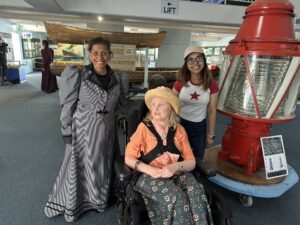
Penny with her Hartley Lifecare Carers exploring Eden
On the final day, since Penny’s wheelchair couldn’t access the sand at the beach, we took her to the Tathra Lookout, where she could enjoy the ocean views from a safe, accessible location. It turned out to be a stunning and peaceful experience for her.
While not everything went exactly to plan, specifically the cruise activity, our flexibility and backup ideas made it a memorable holiday for everyone. Our clients and staff shared moments of joy, laughter, and connection, and the trip truly felt like a family getaway.
This experience reinforced the importance of thoughtful planning, open communication with providers, and a flexible mindset in making tourism accessible, inclusive and enjoyable for all.
Looking back, we will plan tours with more stable access points or have an alternative activity pre-planned for such scenarios in the future.
Find out more:
Hartley Lifecare | enquiries@hartley.org.au | 02 6282 4411 | www.hartley.org.au
Tathra Beach House | book@tathrabeachhouse.com.au | 02 6499 9900 | www.tathrabeachhouse.com.au
Resources
Destination NSW Accessible & Inclusion Webinar Series
This webinar series is presented in partnership with Get Skilled Access, founded by Paralympian and disability advocate Dylan Alcott AO, as part of the NSW First Program. They each provide useful advice and resources for tourism businesses wishing to improve their accessibility and inclusivity.
Webinar #1: Disability Inclusion in the Visitor Economy
Webinar #2: Inclusive Customer Service
Webinar #3: Creating Accessible Digital Content
A platform offering detailed information on accessible travel destinations, services, and experiences for travellers with accessibility needs, and expert advice for tourism operators.
Disinfluencer provides excellent advice to support operators access inclusivity tools and expertise, including stock images, talent management, access to social media influences and specialist training.
The Welcome with Pride platform delivers programs that empower tourism businesses to win high-value LGBTIQ+ guests through consistently inclusive experiences, and an authentic, proven commitment to LGBTIQ+ inclusivity.
The Accessible Group offers consulting services, accreditation programs, and workshops to help businesses enhance their accessibility and inclusivity.
Tourism Australia Accessible Tourism
The TA Accessible Tourism website provides insights into making tourism products and services accessible and provides information about relevant policies and legislation.
Australian Government Accessible Tourism
This is a compilation of websites, programs, and specialists to assist tourism operators in creating more accessible and inclusive businesses
The WELCOME Framework encourages tourism operators to view accessibility and inclusivity as a universal approach to business.
The Framework brings together important aspects for tourism operators to consider in making their products and services more accessible. It guides them in understanding the needs of, and promoting their business to, the accessible tourism community.
Australian Tourism Industry Council – Accessible Tourism
ATIC’s Accessible Tourism program provides businesses with a comprehensive online accessibility assessment and an Accessibility Information guide for visitors.
Canberra Region Tourism Industry Council
The Accessible Tourism program provides businesses with a comprehensive online accessibility assessment and an Accessibility Information guide for visitors. Businesses meeting essential criteria are recognised across support areas of cognitive/autism, limited mobility, low hearing, low vision, wheelchairs, and scooters.
NSW Tourism Association (accreditation included in Membership)
The Accessible Tourism program provides businesses with a comprehensive online accessibility assessment and an Accessibility Information guide for visitors. Businesses meeting essential criteria are recognised across support areas of cognitive/autism, limited mobility, low hearing, low vision, wheelchairs, and scooters.
Tourism Research Australia (TRA) – Accessible Tourism in Australia
This report provides data and insights regarding travellers with accessibility needs in Australia. These insights have been drawn from data obtained from Austrade’s National Visitors Survey in the June quarter (April, May and June) 2023.
There are 5 main topics in the report:
- Size and scope of the domestic accessible tourism market
- Spending profile of travellers with accessible needs
- Characteristics of travellers with accessibility needs
- Reasons for travel and activities
- Accommodation and travel party types of overnight travellers
Sparrowly Group Report Accessible Tourism Report
Pathway
Accessibility & Inclusion
← Back to pathway
Phase
Introduction
← Back to phase
Section
Getting Started
You are here